Autonomous Drones in Silicon Valley Enterprises 2026
Explore a data-driven perspective on how autonomous drones in Silicon Valley enterprises in 2026 are reshaping and transforming operations.

Amara Singh is a seasoned technology journalist with a background in computer science from the Indian Institute of Technology. She has covered AI and machine learning trends across Asia and Silicon Valley for over a decade.
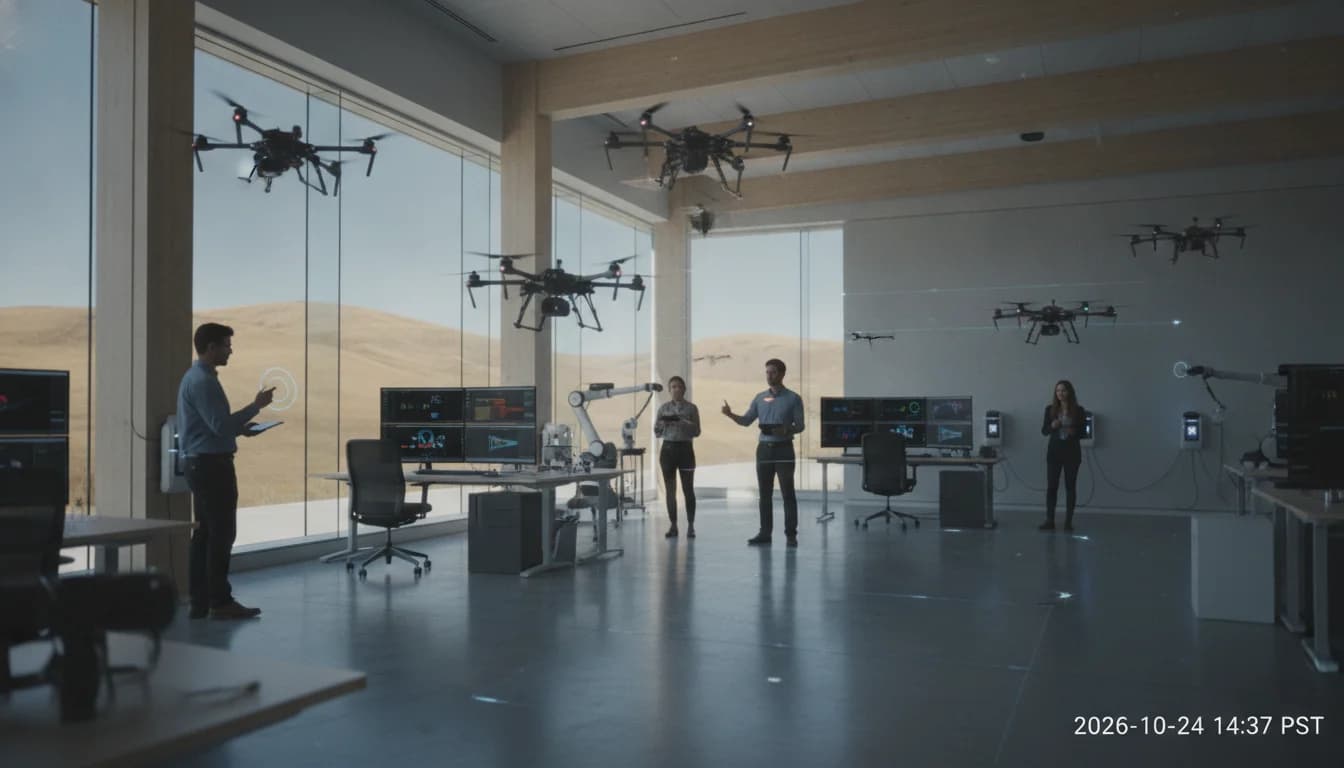
Autonomous drones in Silicon Valley enterprises 2026 are no longer a theoretical curiosity; they have begun to touch the operational nervous system of some of the region’s most demanding enterprises. In 2026, a growing chorus of pilots, operators, and IT leaders are testing the idea that autonomous drones can augment and, in many cases, redefine how work gets done—ranging from critical inspections of infrastructure to time-sensitive medical deliveries and on-demand logistics. The momentum isn’t coming from a few shiny demos but from a shift in how firms approach autonomy as a strategic capability, not just a gadget in the tech toolkit. This shift is happening at scale in the United States, and it is increasingly visible in California’s innovation hub. The question is not whether autonomous drones have a place in Silicon Valley enterprises 2026, but how quickly the ecosystem can marry regulatory clarity, safety, and enterprise-grade software to unlock durable value. For readers of the Stanford Tech Review, the answer is data-driven: autonomy is expanding the envelope of what’s possible, but only with deliberate governance, robust cloud-and-edge integration, and disciplined risk management. Later this year in the Valley, you’ll see autonomous drone-enabled services extend from pilot programs into ongoing, regulated operations, signaling that autonomous drones in Silicon Valley enterprises 2026 are entering a new phase of practical scale. (axios.com)
My thesis is clear: autonomous drones in Silicon Valley enterprises 2026 will deliver real, calculable value not merely by replacing humans, but by multiplying human capability through continuous operations, smarter decision-making, and tighter integration with enterprise data platforms. This is not a speculative horizon; it’s a data-driven shift that demands new governance models, new talent practices, and new regulatory navigation. The path forward is not frictionless, but the trajectory is becoming undeniable as regulators move toward normalized BVLOS (beyond-visual-line-of-sight) operations, and as domestic drone innovation accelerates to meet enterprise needs across healthcare, utilities, manufacturing, and logistics. The coming year will reveal both the opportunities and the frictions that determine whether this is a long runway or a rapid ascent. The broader context matters, because Autonomous drones in Silicon Valley enterprises 2026 are not an isolated tech trend—they’re part of a wider movement toward AI-enabled autonomous systems integrated with cloud, edge, and data governance practices that define modern enterprise operations. (faa.gov)
Section 1: The Current State
The Current State: Context, Perceptions, and Pace
Adoption momentum and market signals
Across the United States, 2026 has begun to show a tangible shift from pilot programs to scalable deployments in enterprise environments. A leading driver is the growing capability of autonomous platforms to operate under regulatory regimes that are shifting toward BVLOS-enabled workflows, with policymakers and industry players aligning around safer, more efficient operations. This isn’t a fringe trend confined to a single sector; it is reconfiguring logistics, asset inspection, and service delivery in multiple industries. The commentary around Beyond Visual Line of Sight (BVLOS) rules highlights a deliberate move toward normalized, scalable drone operations, signaling that the valley’s enterprises are serious about reaping the benefits of autonomy at scale. (faa.gov)
The regulatory backdrop and safety-first infrastructure
The FAA’s ongoing work on BVLOS, waivers, and regulatory modernization provides the scaffold for enterprise autonomy to proliferate. The agency’s BVLOS framework centers on safety, deconfliction, and accountability, with regulatory pathways that include waivers and structured procedures for managed operations. This framework matters for Silicon Valley institutions that aim to deploy autonomous drones in complex environments, where careful routing, data integrity, and compliance are non-negotiable. While the path to scale is not entirely frictionless, the regulatory arc is trending toward clearer, repeatable processes that support enterprise autonomy rather than impede it. (faa.gov)
Real-world deployments and regional exemplars
In Silicon Valley and beyond, autonomous drone activity is increasingly anchored by enterprise-grade platforms, asset-management use cases, and logistics pilots that demonstrate repeatability and safety in real-world settings. The emergence of large-scale deployment narratives around drone delivery, infrastructure inspection, and public-safety applications provides a compelling read on 2026’s trajectory. While many deployments remain partners’ pilots or phased rollouts, the signal is unmistakable: autonomous drones in Silicon Valley enterprises 2026 are moving from novelty to near-term necessity in certain regulated, asset-intensive environments. A notable example of U.S. expansion is the accelerating adoption of autonomous delivery services in and around major metros, with Valley-area coverage contemplated in 2026 as part of broader national expansion plans. This trajectory is underscored by industry coverage of funding rounds and market expansions that pin the United States as a focal point for autonomous-drone-enabled logistics and services. (techcrunch.com)
The valley’s ecosystem: a convergence of startups, incumbents, and policy
Silicon Valley remains a hotbed for autonomy research, hardware-software co-design, and cloud/edge integration that makes drone programs both scalable and governable. Academic and corporate collaborations, coupled with a policy environment that increasingly recognizes BVLOS and automation as legitimate enterprise capabilities, shape the practical pathways for 2026. Stanford, for its part, continues to host and publish policy and research discussions around UAV operations, safety, and governance, highlighting the broader ecosystem’s emphasis on responsible, data-driven progress. This convergence—research, enterprise pilots, and policy dialogue—creates the conditions for Autonomous drones in Silicon Valley enterprises 2026 to translate from theory into measurable operational improvements. (doresearch.stanford.edu)
Section 2: Why I Disagree
Why I Disagree with the notion that autonomy will merely replace people
1) Autonomy multiplies human capability, not simply replaces it
One of the most persistent anxieties about autonomous drones is the fear that they will supplant human labor. In practice, the most compelling narratives in 2026 show autonomy expanding the scope and scale of human-facing operations—dispatching drones to hard-to-reach sites, performing repetitive inspection cycles, and enabling continuous delivery in regulated environments. The value proposition isn’t just “more drones” but “more capable operations” that were previously constrained by human availability, safety concerns, or the cost of round-the-clock coverage. For instance, autonomous delivery platforms operating in expansive markets illustrate how autonomous drones can run at scale with reduced human-in-the-loop requirements, particularly in routine, well-defined tasks. In 2026, these dynamics are increasingly visible in enterprise logistics and public-safety workflows, underscoring that the practical impact of Autonomous drones in Silicon Valley enterprises 2026 lies in augmenting human teams rather than replacing them wholesale. This conclusion aligns with ongoing industry coverage of multi-drone operations and regulated autonomy, which points to a future where automation and human expertise co-exist and reinforce one another. (techcrunch.com)
2) Regulatory progress is real but not fully normalized
A common misperception is that regulatory barriers are a distant concern or will quickly vanish. In reality, the 2026 regulatory landscape remains a mix of progress and ongoing complexity. The FAA’s BVLOS initiatives and waiver pathways are delivering clearer routes to scale, but these pathways remain contingent on rigorous safety, deconfliction, and governance requirements. The Section 927 waiver process, and related regulatory updates, illustrate that enterprise drone programs must embed formal approval workflows, risk assessments, and documentation as part of standard operating procedures. This is not a purely technical hurdle; it is a governance challenge that will influence how quickly and how broadly Silicon Valley enterprises can institutionalize autonomous drone operations. Autonomy in 2026 thus relies as much on policy design as on algorithmic sophistication. (faa.gov)
3) Data governance, privacy, and security matter as strategic capabilities
A second set of counterarguments centers on data governance and security. The use of autonomous drones in value chains raises questions about data collected in flight, storage of footage, and integration with enterprise data platforms. The Stanford DoResearch and university policy pages emphasize the importance of safety, compliance, and risk-control mechanisms when UAVs operate on or near university and commercial sites. If Silicon Valley enterprises are to realize durable value from Autonomous drones in Silicon Valley enterprises 2026, they must treat data governance as a first-order capability—well before cost and performance considerations, and with explicit standards for privacy, access controls, and threat modeling. The governance perspective is not a barrier but a prerequisite for scaling autonomous drone programs. (doresearch.stanford.edu)
4) Domestic innovation and supply-chain resilience shape the economics
A final counterargument concerns the broader technology stack that underpins autonomous drones. The U.S. emphasis on domestic autonomy hardware, AI software, and compliant supply chains matters for enterprise cost structures and risk management. 2026 coverage of domestic investment—ranging from AI-enabled flight control chips to regulatory-compliant autonomy platforms—signals that Silicon Valley enterprises may increasingly prefer locally manufactured components and software foundations to reduce dependence on foreign-sourced supply chains and regulatory uncertainty. In this sense, the Valley’s autonomous drone programs are not just pilots of a new technology but tests of a broader economic strategy to improve resilience and control over critical operational capabilities. This trend is echoed by industry-finance reporting around U.S.-based drone innovation funding and chip-stack localization. (fortune.com)
Section 3: What This Means
What Autonomous drones in Silicon Valley enterprises 2026 implies for the future
Implications for enterprise leadership and IT governance
If Autonomous drones in Silicon Valley enterprises 2026 are to deliver durable value, C-level and board-level leadership must treat autonomy as a core enterprise capability—on par with cloud, data platforms, and cybersecurity. This means instituting formal governance for drone programs, aligning them with risk management, privacy, and information security policies, and ensuring that drone data integrates cleanly with enterprise analytics workflows. It also means designing for BVLOS-enabled operations within a modular architecture that can scale across sites, functions, and teams. The regulatory trajectory supports this shift, but it also requires a disciplined program-management approach: standardized waivers, auditable flight logs, and clear lines of accountability for safety, privacy, and security. For Silicon Valley enterprises, the payoff is not only faster inspections or faster deliveries; it’s the ability to derive actionable operational intelligence from aerial data at enterprise scale. This is precisely where Autonomous drones in Silicon Valley enterprises 2026 begin to converge with broader digital-transformation agendas. (faa.gov)
Policy, standards, and ecosystem coordination
Policy makers and industry consortia will play a decisive role in shaping the pace and shape of adoption. The BVLOS framework and ongoing regulatory modernization—along with waivers and standards for automation—will determine how quickly valley-based enterprises can deploy autonomous fleets across multiple operations. A policy landscape that encourages standardized processes, interoperability, and safety-by-design reduces friction for large-scale deployments and supports the data-driven business models that Silicon Valley firms are known for. From a practical standpoint, enterprises should monitor regulatory developments and participate in open, constructive conversations with regulators and standards bodies so that autonomy capabilities can be deployed with predictability and governance that matches their risk profiles. This alignment between policy and practice is essential for the long-term health of Autonomous drones in Silicon Valley enterprises 2026 and its broader economic implications. (faa.gov)
Ecosystem dynamics: capacity, collaboration, and talent
Silicon Valley’s ecosystem—comprising startups, incumbent technology providers, academia, and public-sector partners—must collaborate to realize the full value of autonomous flight. The region’s concentration of AI, robotics, cloud, and systems-integration expertise provides a unique advantage for building end-to-end drone programs that traverse flight, data processing, and enterprise-scale decision-making. Investments in autonomous drones in Silicon Valley enterprises 2026 will likely be complemented by domestic manufacturing efforts and talent ecosystems, as evidenced by market signals around chip development and U.S.-based autonomy stack innovation. Enterprises should seek partnerships that reinforce safety, resilience, and data governance while investing in internal capabilities to translate aerial data into actionable business insights. The broader market signals—ranging from delivery-scale pilots to regulatory advances—support a narrative in which Silicon Valley remains a leadership hub for autonomy-enabled enterprise operations. (fortune.com)
Closing
Autonomous drones in Silicon Valley enterprises 2026 can be read as a data-rich inflection point rather than a speculative forecast. The evidence suggests a trajectory toward scalable, regulated, and governance-driven autonomy that accompanies, and in many cases amplifies, human capability. That does not erase the challenges—the regulatory path, data governance, and supply-chain considerations demand deliberate, accountable action—but it does provide a clearer view of the direction. For practitioners, the path forward is to treat drone autonomy as a strategic platform: invest in security and governance, design cross-functional workflows that leverage aerial data, and engage with policymakers to help shape a pragmatic, safe, and scalable future. If the valley can align policy, technology, and people around a shared set of standards and outcomes, Autonomous drones in Silicon Valley enterprises 2026 could become a defining feature of enterprise operations—not merely a novelty, but a reliable, value-creating capability that redefines what’s possible in the heart of technology’s epicenter. (faa.gov)