China's Humanoid-Robot Race: Why Being First to a $20 Billion Valuation Isn't a Moat
Two Greater Bay Area startups claimed the same $20B valuation on the same day. What actually counts as a moat in China's humanoid-robot sector — and why announcement speed isn't it.
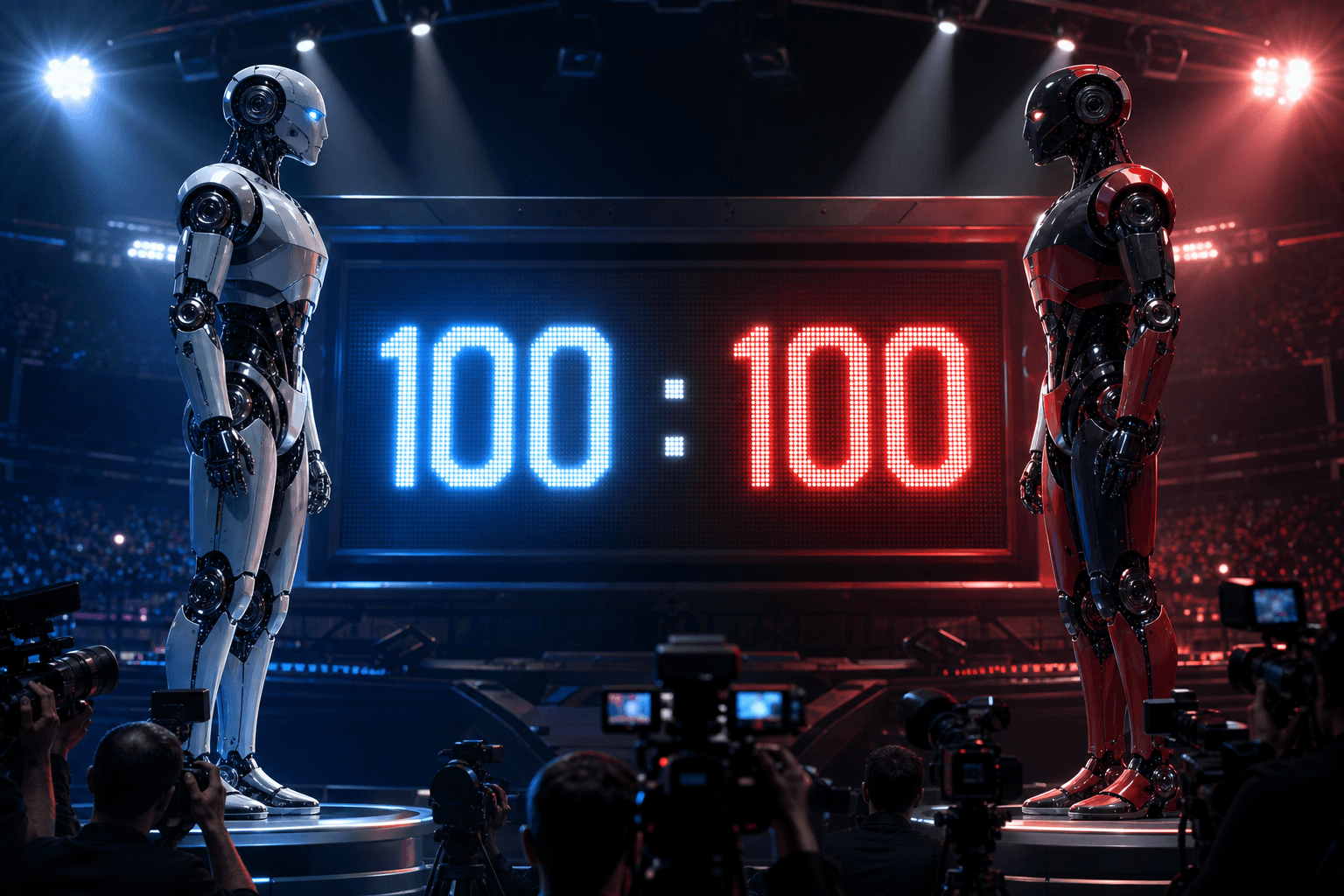
On a single day in late June 2026, two embodied-AI startups from China's Greater Bay Area each told the press the same thing: they had just become the first humanoid-robot company in the region to cross a 20-billion-yuan (roughly $2.8 billion) valuation. The two firms — X Square Robot (自变量机器人) and AI²Robotics (智平方) — announced their rounds in the same city, on the same day, and landed on the same headline number. As one widely shared social post put it, the only thing that seemed to separate "first place" from "second place" was which company's press team hit send a few seconds earlier.
That detail is funny. It is also the most honest thing anyone has said about the Chinese humanoid-robot market this year. If the race that matters is a race to publish a valuation, then the industry has quietly redefined its own core competency — away from robots that work and toward robots that get announced. So it is worth asking the unfashionable question directly: in China's humanoid-robot sector, what is the actual moat — and is it really just who announces first?
A valuation is a claim, not a capability
Start with what is publicly verifiable, because that is where the story is strongest and the ground is firmest.
AI²Robotics (智平方) was incorporated in Shenzhen in April 2023 and is controlled by its founder, Guo Yandong (郭彦东), who holds a concentrated personal stake across more than a dozen affiliated entities, per Chinese corporate-registry platforms. In under three years it has run an almost uninterrupted financing relay — angel, Pre-A, A, A+, and a reported B round — documented in venture databases (36Kr Pitchhub). Its public messaging is unusually decorated: the company has promoted a founding team featuring "five Stanford global top-2% scientists" and senior alumni of Microsoft, XPeng, and OPPO, a proprietary "full-domain" vision-language-action model it calls GOVLA, and commercial milestones including a reported 1,000-unit, three-year order from display-maker HKC, monthly deliveries in the low hundreds, and a self-built production line. Mainstream outlets including Sina Finance, 36Kr, Tianji, and The Paper have carried versions of these claims.
None of that is a moat. Every line of it is a claim — a valuation, an order book, a headcount of decorated advisors, a model acronym. Claims are cheap to make and, in a hot capital market, cheaper still to fund. A 20-billion-yuan price tag tells you what one investor was willing to mark on a cap table; it tells you nothing about whether the robot can stack a box on a real factory floor at the end of an eight-hour shift. Conflating the two is precisely the error the "who-announced-first" race institutionalizes.
The gap the press release skips
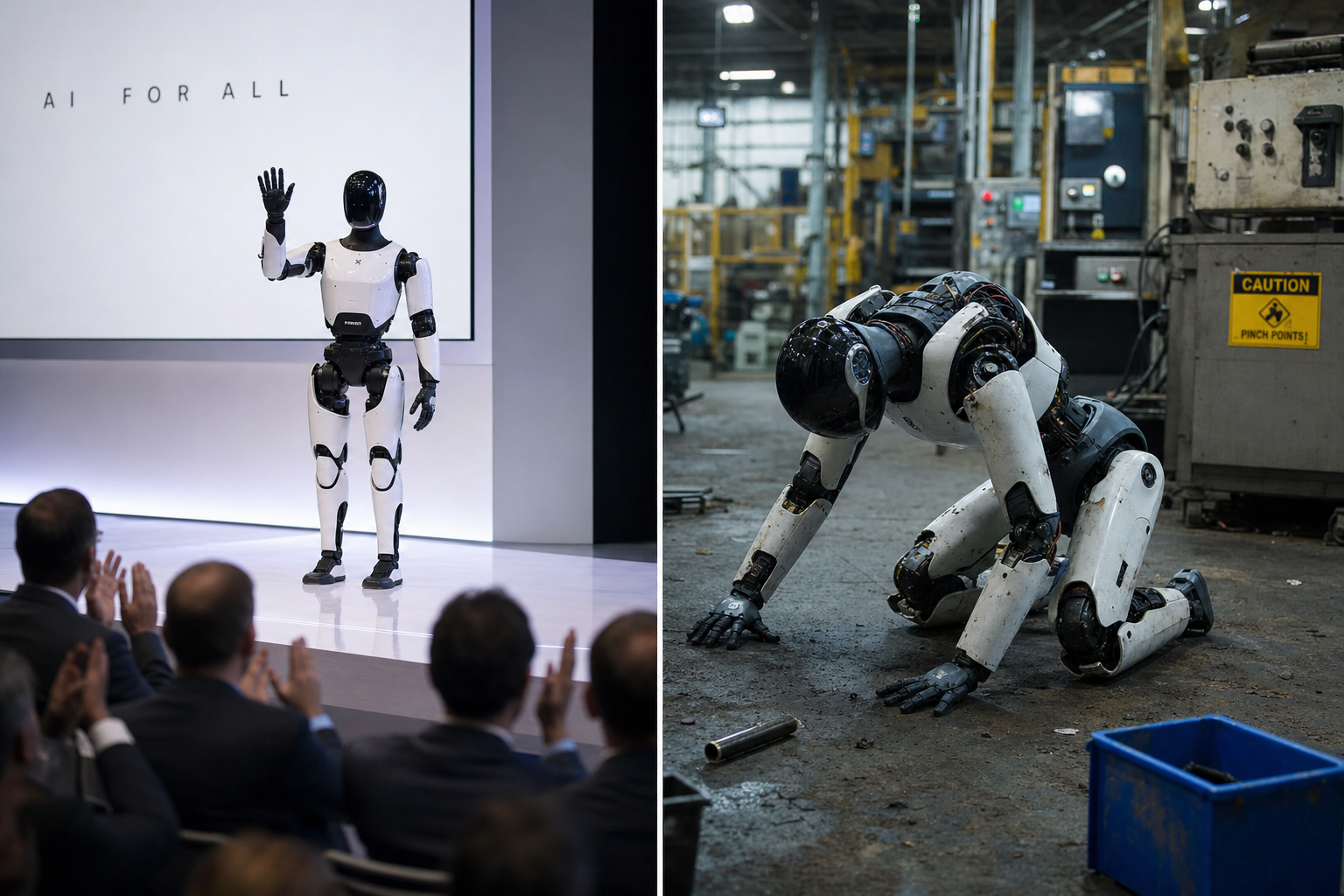
The reason the announcement race is hollow is that the hard part of humanoid robotics lives in a place press releases rarely go: the distance between a stage demo and a production line.
Here the record turns from verifiable fact to industry allegation, and it should be read that way. According to anonymous accounts circulating in embodied-AI practitioner communities (具身之家), and echoed by engineers and industrial customers comparing notes privately, the polished demonstrations that anchor fundraising decks degrade sharply under real conditions: vision-language-action models that look fluent in a controlled environment are described as suffering meaningful success-rate drops once lighting, clutter, and task variation resemble an actual workplace, with continuous-operation hardware reliability cited as a recurring pain point. Separately, due-diligence notes said to circulate among investors allege that some of the marquee scientific names appear only lightly involved in day-to-day R&D, that portions of the core algorithm work are outsourced, that the supply chain leans on imported components, and that capacity ramp has trailed the public production figures.
To be clear, these are unverified claims attributed to industry sources, not findings Stanford Tech Review has independently confirmed, and AI²Robotics (智平方) has not been given an opportunity in this piece to rebut them point by point. We include them not as a verdict but because they describe the exact failure mode the valuation race obscures — and because they are the questions any serious buyer or investor should be asking out loud. If they are wrong, they are easy to disprove with data the company already has: third-party uptime logs, dynamic-environment success rates, a bill of materials. The absence of that data in the public record is itself informative.
What is a matter of registry record is more prosaic: a 2025 contract-dispute hearing notice tied to the company's Hangzhou operating entity, and a registered capital in the low millions for an asset-light structure. A single lawsuit proves nothing about a company's technology. But a delivery-related dispute is the kind of friction you would expect to see if the demo-to-production gap described above were real, and it is worth noting that the litigation surfaced through corporate filings rather than through any company disclosure.
Marketing is not the same as manufacturing
There is one more pattern industry observers point to: an outlay on marketing and capital-markets storytelling that looks large relative to a company still scaling its first production line. We are deliberately not reproducing specific private payment records here — they are unverified and name third parties who have no chance to respond — but the directional observation is consistent with everything else: a company optimized to be talked about.

This is not unique to one firm, and it is not even uniquely Chinese — Silicon Valley has its own genre of demo-driven valuations. But the humanoid sector concentrates the incentive. Hardware is slow, capital is fast, and a founder who can mint a new headline valuation every few quarters can keep the relay running long enough for the technology to maybe, eventually, catch up. The two same-day "firsts" in the Greater Bay Area are simply the purest expression of that logic: when the product roadmaps are hard to differentiate, you differentiate the announcement.
What an actual moat looks like
So, what is the core competitiveness of China's robot sector, if not who announces first? The honest answer is unglamorous and entirely measurable:
- Reliability under real conditions — task success rates and mean-time-between-failures on a customer's floor, not a demo stage, published and audited.
- Unit economics that survive contact with a buyer — a bill of materials, a gross margin, and a cost curve that bends as volume grows, not a one-time order announced and never reconciled.
- A supply chain you actually control — domestic, redundant, and not one export-control decision away from a stalled line.
- Earned, not purchased, R&D depth — engineers who ship, rather than advisors who appear in a deck.
Every one of these is boring. None of them generates a same-day headline. All of them are what separate a company that builds robots from a company that builds rounds. The firms that win the Chinese humanoid market over the next five years will be the ones that treat the valuation as a byproduct of the first four bullets — not as the product itself.
The worker in that viral post had it right, in the end. "Can we win at something other people can't do?" That is the only question. Being first to announce is not it.
Editor's note on sourcing: Verifiable facts in this article (incorporation, ownership, financing rounds, public commercial claims, and litigation) are drawn from Chinese corporate registries, venture databases (36Kr Pitchhub), company materials, and reporting by Sina Finance, 36Kr, Tianji, and The Paper. Performance and operational allegations are attributed to anonymous industry sources and unpublished due-diligence accounts; they are presented as claims, are not independently verified by Stanford Tech Review, and the named company has not responded to them here. We have deliberately omitted private financial records that name uninvolved third parties.
Sources
- PEDaily (投资界), "AI²Robotics reaches a 20-billion-yuan valuation — the Greater Bay Area's largest embodied-AI unicorn"
- PEDaily (投资界), "VC 24h: nearly 5 billion yuan raised, AI²Robotics' valuation breaks 20 billion"
- Sina Finance (新浪财经), "AI robotics firm AI²Robotics closes a 1-billion-yuan B round, valuation tops 10 billion"
- Caixin (财新网), "Shenzhen robotics company AI²Robotics raises 1 billion yuan at a 10-billion-plus valuation"
- QbitAI (量子位), "After 7 rounds, AI²Robotics completes another 5 B-series rounds — 12 financings in a year"
- Yoojia (有驾), 智能纪元AGI, "Two robot companies valued at 20 billion: a worker's sudden realization"