Nvidia, BlackRock, KKR Launch $500B AI Factory Financing
Nvidia partners with Apollo, BlackRock, Blackstone, Brookfield, Goldman Sachs and KKR on platforms to mobilize over $500 billion for AI factory infrastructure.

Data journalist covering markets, platforms, and the economics of rating systems.
Nvidia announced on Sunday that it will partner with Apollo, BlackRock, Blackstone, Brookfield, Goldman Sachs and KKR to create independent financing platforms intended to mobilize more than $500 billion of third-party capital for AI infrastructure. CEO Jensen Huang made the announcement personally, in a lengthy post on X titled "NVIDIA AI Factory Compute Is Becoming an Investable Asset Class."
The framing is the story. Chips depreciate; asset classes get underwritten, financed and traded. Huang is asking the world's largest infrastructure investors to treat a rack of GPUs the way they treat a toll road or a power plant: a long-lived productive asset with cash flows, a resale market and residual value.
NVIDIA AI Factory Compute Is Becoming an Investable Asset Class
Today, we announced partnerships with Apollo, BlackRock, Blackstone, Brookfield, Goldman Sachs and KKR to establish independent financing platforms designed to mobilize over $500 billion of third-party capital to support the buildout of AI infrastructure over time.
This is a major milestone for NVIDIA and the AI industry. We have moved from an era in which companies bought chips and built data centers project by project to one in which AI factories can be financed as productive infrastructure. AI has reached an inflection point. It is moving from research into production. In AI, compute is revenue.
— Jensen Huang (@JensenHuang) August 10, 2026
What was actually announced
According to Huang's post, the six institutions will run "repeatable financing platforms" that lend to qualified AI labs, enterprises and cloud providers who need compute but lack access to capital at the required scale. The $500 billion figure is aggregate third-party capital the platforms are designed to mobilize over time. It is not Nvidia revenue, not a single fund, and not a commitment to any single customer.
Nvidia's own exposure is deliberately capped. In some cases the company may provide a residual-value support mechanism for up to 25 percent of an opportunity, assessed project by project. The financial institutions underwrite each deal independently, evaluating the customer, demand, utilization, cash flow and residual value.
The case that compute holds its value
The economic argument rests on two claims: that Nvidia hardware stays productive far longer than its depreciation schedule suggests, and that rental prices for that hardware are rising, not falling.
Huang cites the A100, introduced in 2020 and still being committed to multi-year deployments six years later, with an economic life he says now extends "toward a decade." On pricing, the post's own figures show one-year H100 rental rates rising roughly 38 percent in six months, from about $1.70 per GPU-hour in October 2025 to about $2.35 in March 2026, while cross-provider on-demand median pricing climbed from roughly $2.00 to $2.70 per GPU-hour between October 2025 and June 2026. Blackwell B200 capacity commands $5.30 to $7.05 per GPU-hour.
The software layer is the other half of the pitch. Because CUDA updates improve the throughput of already-installed hardware, Nvidia argues an AI factory produces more intelligence per dollar every year it operates, which is the opposite of how underwriters normally model computing equipment.
The circular financing question
Huang addressed the most common criticism head-on, under the literal heading "Is this circular financing?" His answer is that this structure is designed to do the opposite: replace vendor-financed and equity-cross-invested deals with independent institutional capital that underwrites each project on its own economics. The 25 percent cap on residual-value support, he notes, is "substantially lower than other compute-financing arrangements."
Skeptics will point out that a demand guarantee from the chip vendor, even a partial one, still ties Nvidia's balance sheet to the success of its customers. But the announcement is best read as an attempt to standardize AI compute as collateral, the way securitization once standardized mortgages: whoever writes the underwriting rules for a new asset class gets to define what the asset is worth.
The early reaction
The post drew more than 211,000 views and nearly 3,000 likes within its first hours, and the replies skewed enthusiastic rather than skeptical. Retail investors in GPU-adjacent stocks celebrated openly, with one reply thanking Huang on behalf of IREN shareholders anticipating Vera Rubin capacity at the company's Sweetwater site, and others simply asking "wen deal." The market read it less as a financing mechanism than as a signal: the world's most valuable chipmaker just told six of the world's largest asset managers that AI compute is safe to lend against.
Every industrial revolution has been financed by someone. Electricity had utilities bonds, railroads had land grants, telecoms had junk bonds. If Huang gets his way, AI factories will have infrastructure funds, and the $500 billion is meant to be the opening bid.
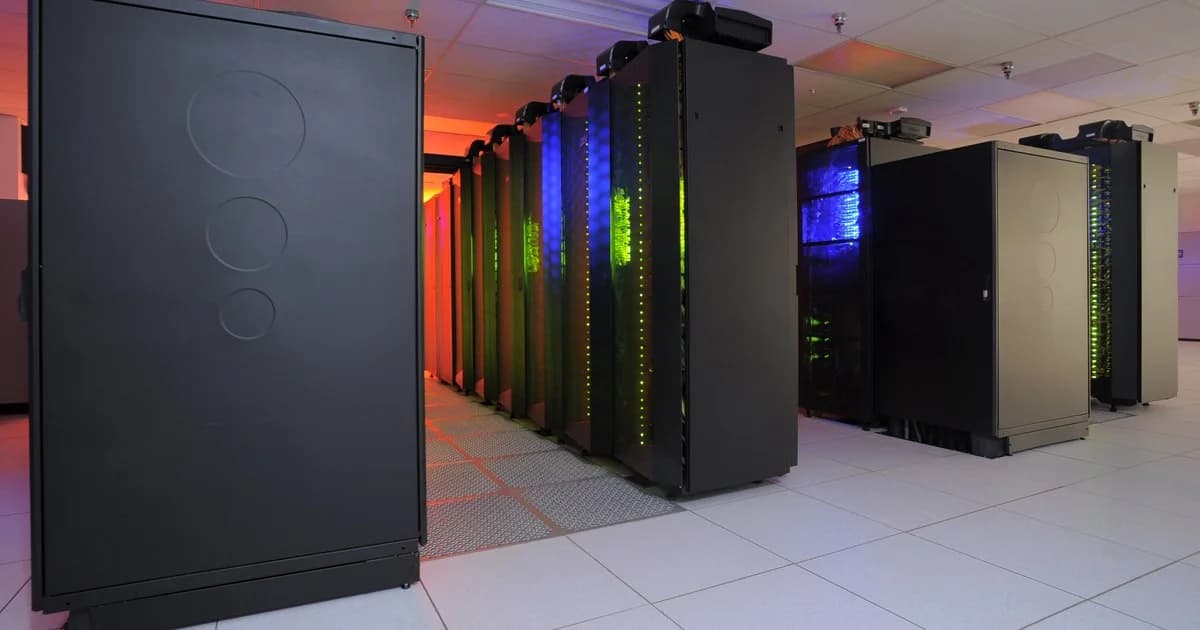
Cover image: the Discover supercomputer at NASA Goddard Space Flight Center. Public domain, NASA.